

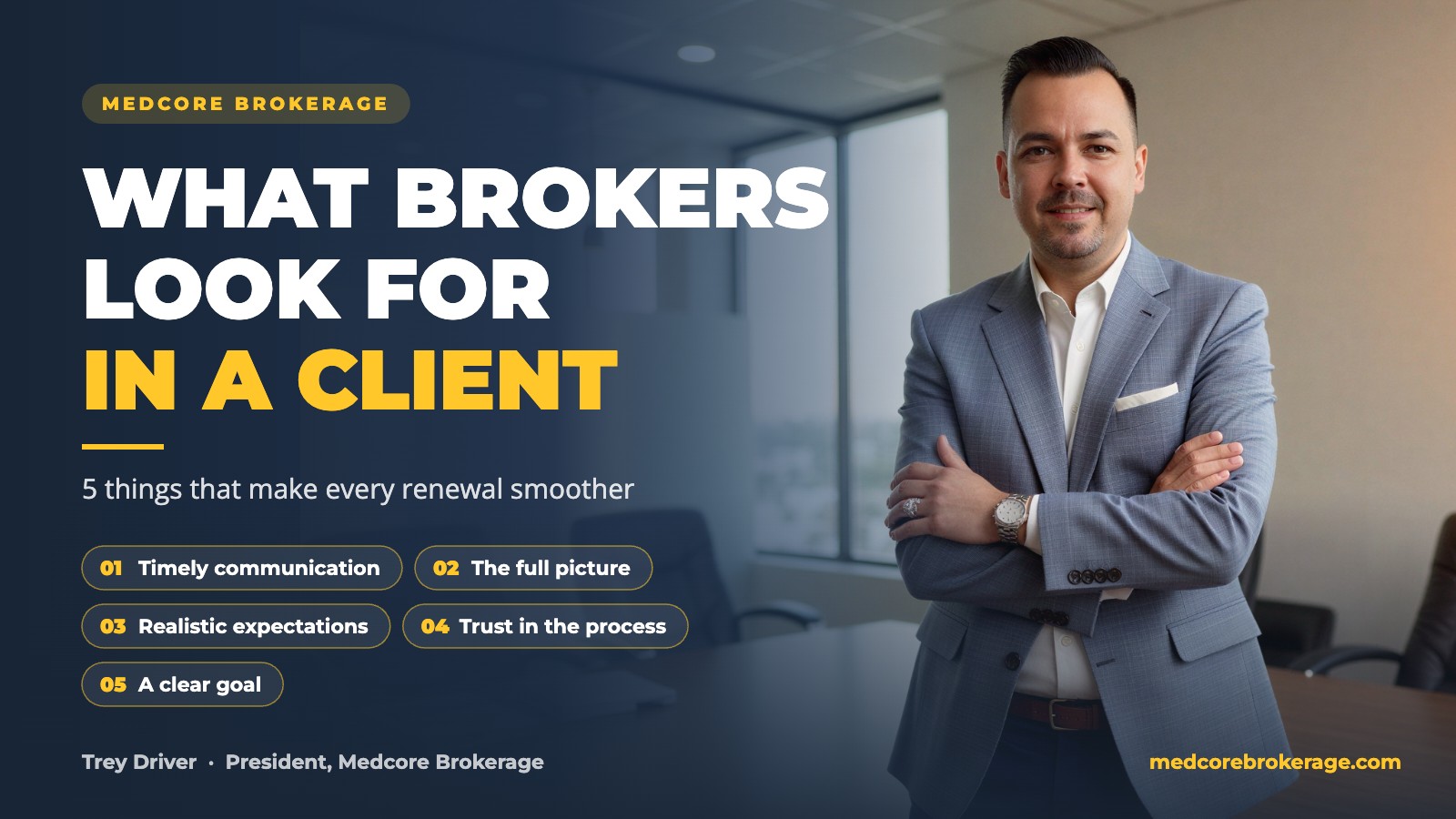
What brokers look for in a client comes down to five things: timely communication, openness about the full picture, realistic expectations about what a broker controls, trust in the process, and a clear sense of whether you are shopping for a better broker or just a better price. Clients who bring those five to the table get smoother renewals, more carrier options and better support for their employees.
When an employer meets with a new benefits broker, it usually feels like a one-way interview. You ask the questions, compare the answers and decide who earns your business. But a good broker is evaluating the fit too. I’m Trey Driver, President of Medcore Brokerage, and I have worked with Texas employers since 2012. In a first meeting I’m gathering the obvious information, like your renewal, your carriers, your enrollment platform and what you’re trying to solve. I’m also thinking about what working together will look like, not just for this renewal, but for the next one and the one after that.
The 5 things brokers look for in a client
- Timely communication: replies that keep quotes, applications and enrollment on schedule.
- The full picture: the real reason for the meeting, plus your census, renewal and claims information.
- Realistic expectations: knowing carriers set rates and brokers control strategy and service.
- Trust in the process: asking questions, then giving the plan room to work.
- A clear goal: shopping for a better broker, not just a lower price from several brokers at once.
Evaluating fit isn’t about being picky. Benefits run on carrier deadlines, enrollment cutoffs and effective dates, and a broker can only move as fast as the information and decisions coming from the employer. When the working relationship is strong, renewals go smoother, options stay open, and employees get better support.
Timely Communication
Most of the year, a broker shouldn’t need much from you. But a few times a year, timing matters a lot: a carrier quote window, a signed application, an enrollment deadline.
I start my clients’ renewals about 90 days before the effective date. That cushion is where the real work happens, from comparing carriers to testing alternate plan designs. When replies come back within a day or two during those stretches, that time goes toward finding you better options instead of chasing paperwork.
Brokers notice this early. A client who stays responsive makes every renewal easier for both sides.
Being Open About the Full Picture
A broker can only solve the problem they can see.
In a lot of first meetings, the conversation circles the real issue without quite landing on it. Maybe it’s a strained relationship with the current broker, employee complaints, a big claim, or a budget that’s tighter than anyone wants to say out loud. That’s understandable, since these aren’t always easy things to bring up with someone you just met.
Sometimes I’ll simply ask: Is there anything else I should know that would help me solve this? Any problems we haven’t talked about yet? Without the real issue on the table, I can’t tell you honestly whether I can fix it, and you could end up with a solution to the wrong problem.
It also helps to share the basics up front:
- Your current census and renewal notice
- Your claims report, if your carrier provides one
- Your budget, and how much of the cost you’d like employees to share
- What employees like and dislike about the current plan
Our group health insurance quote checklist lists everything a broker typically needs. None of this is meant to put you on the spot. Being candid early just means your broker spends time on what actually matters to your business.
Realistic Expectations
One of the most helpful things a client can understand is what a broker controls and what they don’t.
Brokers don’t set rates. Carriers do, based on your group’s demographics, claims and the market. What a broker controls is plan design, carrier strategy, funding options, how your group is presented to underwriters, and the service you receive all year.
Clients who understand that difference tend to have a much better experience. They see the broker as a strategist and advocate, not someone who can make a rate increase disappear with one phone call.
Trust in the Process
You should absolutely ask questions, and a good broker should explain how the industry works, why your results came back the way they did, and what the plan of action is.
At the same time, the strongest relationships have a level of trust built in. When a broker recommends starting early, gathering a document, or holding off on a decision until more quotes come in, there’s usually a reason tied to the carriers or the timeline. Clients who give the process room to work tend to come out ahead.
Shopping for a Broker, Not Just a Price
This is one of the most common sources of confusion in group benefits.
Some employers are shopping for a better price. Others are shopping for a better broker. Often, it’s a mix of both without a clear direction, and that’s where things get messy. Asking several brokers to quote the same group rarely produces lower rates. Carriers generally work with one broker per group, so it usually leads to duplicate requests, locked-out brokers and delays rather than better pricing. I explain why in more detail in Multiple Brokers for Group Health Quotes? Why It Backfires.
The better path is to decide what you’re really looking for. If it’s a better partner, interview a few brokers, choose the one you trust, and let that broker take your group to market. That’s also why one of my first questions on any quote request is whether you’re already working with someone. It helps both of us avoid work that goes nowhere.
The Bottom Line
A broker relationship is a business partnership. You should expect a broker who services your account year-round, supports your employees directly, and explains every step. In return, brokers do their best work for clients who communicate, share the full picture, and are clear about what they’re trying to accomplish.
If you’re weighing a change, timing matters too. Here’s the best time to change your employee benefits broker, and what to look for in a benefits broker for Texas employers with 50 or more employees.
What Brokers Look For in a Client: Frequently Asked Questions
What do benefits brokers look for in a new client?
Most brokers look for timely communication, openness about the real issue and the group’s data, realistic expectations about what a broker can control, trust in the process, and a clear goal. Those traits make renewals and enrollments run on time and give the broker room to find better options.
Why does a broker ask if I’m already working with another broker?
Carriers generally work with one broker per group. If another broker has already submitted your group to a carrier, a second broker may be locked out of that carrier, so the question saves both sides from duplicate work and delays.
Do benefits brokers set health insurance rates?
No. Carriers set rates based on the group’s demographics, claims and market conditions. A broker controls plan design, carrier strategy, funding options, how the group is presented to underwriters, and year-round service.
How early should an employer contact a broker before renewal?
About 90 days before the effective date is a good target. That leaves time to gather data, compare carriers and test alternate plan designs before deadlines force a rushed decision.
What should I bring to a first meeting with a benefits broker?
Bring your current census, renewal notice, plan summaries and claims report if your carrier provides one, along with your budget, your employee contribution goals and the real reason you are considering a change.
Should I get group health quotes from several brokers?
Usually not. Several brokers quoting the same group rarely lowers rates, because the underlying carrier rates are generally the same no matter which broker submits the group. A better approach is to interview brokers, choose one and let that broker take your group to market.
If you’re a Texas employer heading into a renewal and want a second opinion, Medcore Brokerage is happy to take a look. No pressure either way. If you want to stay with your current broker, that’s great. If not, my number is always there: 972-277-1049.

Written by
Trey Driver
President of Medcore Brokerage in McKinney, Texas. Licensed in Texas and Oklahoma (TX General Lines Agent #1797664) and an insurance agent since 2012, he helps Texas employers with 50 or more employees design and run their benefits.